In Brief
Mexico has launched one of the most ambitious energy expansions in its history, committing to 32,000 MW of new electricity generation by 2030, with 70 percent coming from renewable sources. "For the first time in history, we have projects totaling 32,000 MW… and 70 percent of them are renewable." This shift is backed by major investments, large-scale solar and wind projects, and a regulatory overhaul that finally gives battery storage a clear legal framework. With landmark projects like Puerto Peñasco and Proyecto Oasis already underway, and private capital accelerating EV charging and industrial solar adoption, Mexico's energy system is entering a rapid transformation that will reshape grid dynamics, tariffs, and opportunities for operators across the country.
On June 24, President Claudia Sheinbaum announced an expansion of Mexico's national electricity system that officials described as historic, and the numbers support that description. The plan calls for 32,000 megawatts of new generation capacity before the sexenio closes in 2030, backed by 739 billion pesos in investment. Of that new capacity, 70 percent will come from renewable sources.
"For the first time in history, we have projects totaling 32,000 MW," Sheinbaum said at her morning press conference. "Something historic in six years, and 70 percent of them are renewable."
For Mexican operators, developers, and any business that depends on a reliable and affordable electricity supply, this plan is worth understanding in detail. It is not a vision document. Tenders are already moving, projects are already in the ground, and the regulatory framework that governs how storage, generation, and interconnection work in Mexico has been substantially rewritten in the past eighteen months.
What 32,000 Megawatts Actually Means
To put the scale in context: the federal electricity plan envisions taking Mexico from generating 354 million megawatt-hours per year to 410 million MWh by 2030. The share of renewable energy in the national generation matrix will grow from 23-24 percent today to 38 percent by end of the period, a 15-point jump in five years.
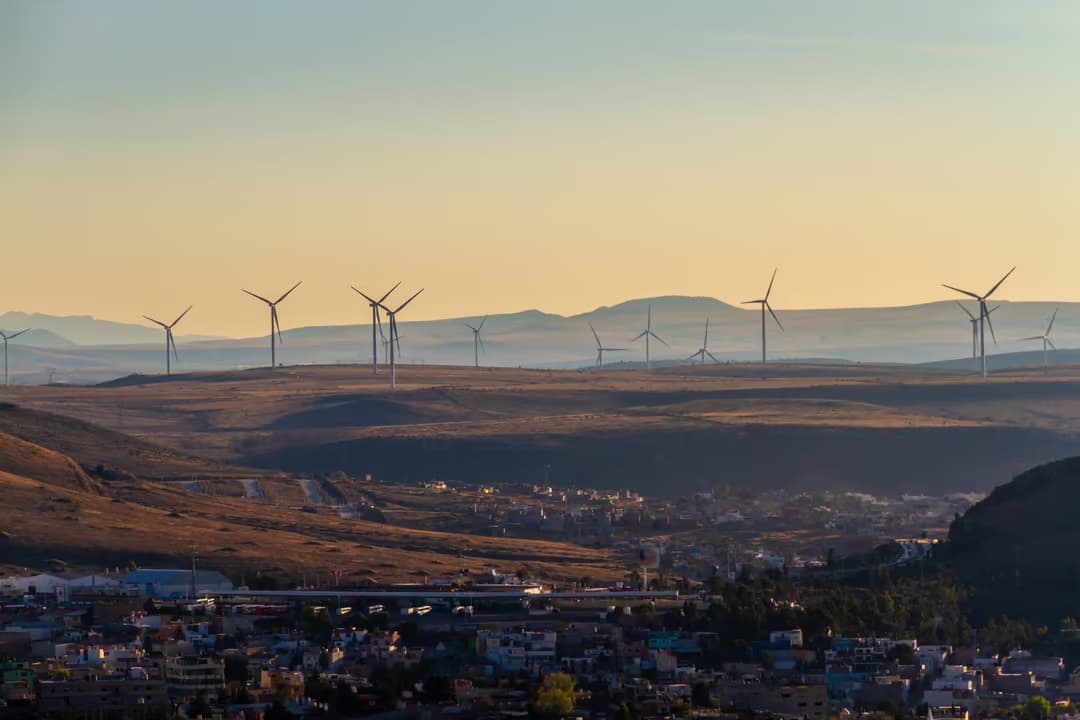
The new renewable capacity breaks down as 12,300 MW of solar photovoltaic and 6,800 MW of wind, plus additions in geothermal and hydroelectric. Solar capacity is set to grow 140 percent relative to its 2024 baseline. Wind grows 70 percent. Geothermal grows 90 percent.
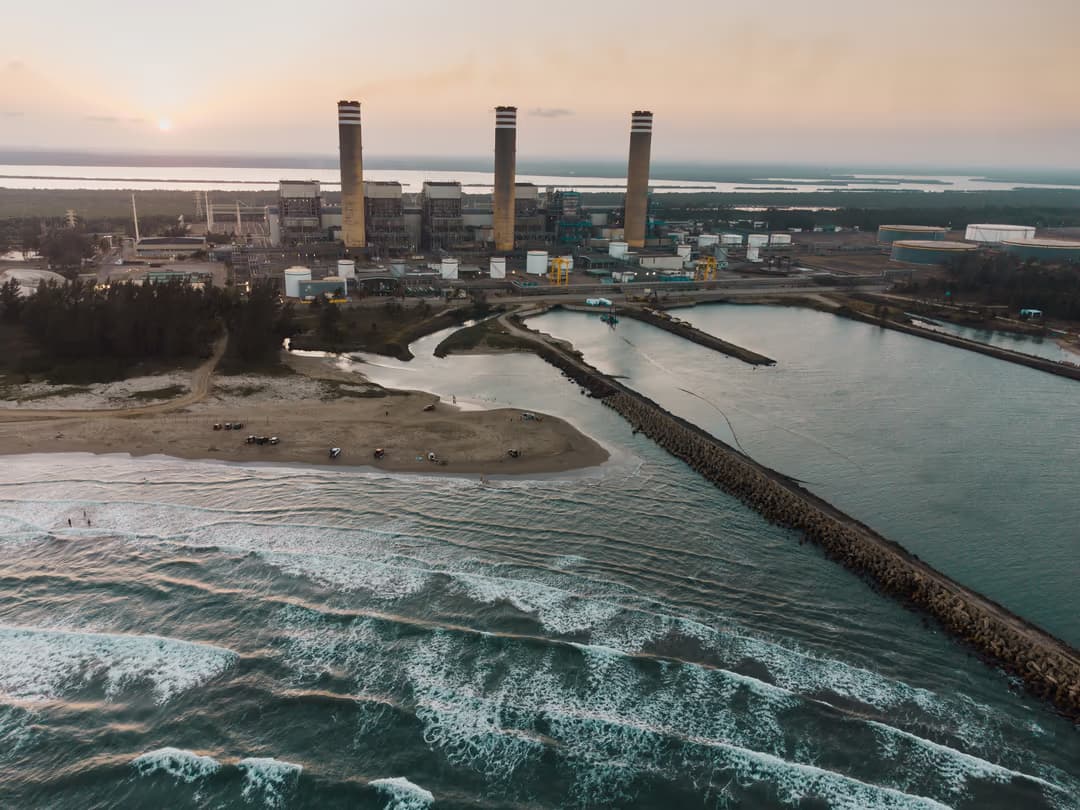
To back those variable renewable sources with firm power, the plan includes five new combined-cycle plants adding 9,900 MW of dispatchable capacity. CFE will contribute 79 percent of total new installed capacity, using its own resources or through mixed-ownership schemes where generation assets remain in state hands. By 2030, the public sector's share of national electricity generation will rise from 43 percent to 61 percent.
The plan is also designed to reduce the electricity sector's dependence on natural gas from 79 percent of generation today to 62 percent, while eliminating 69 million tons of CO2 equivalent emissions relative to the trajectory the country was on.
The Two Projects That Summarize the Ambition
Of all the announcements made on June 24, two projects illustrate what the administration means by energy transformation.
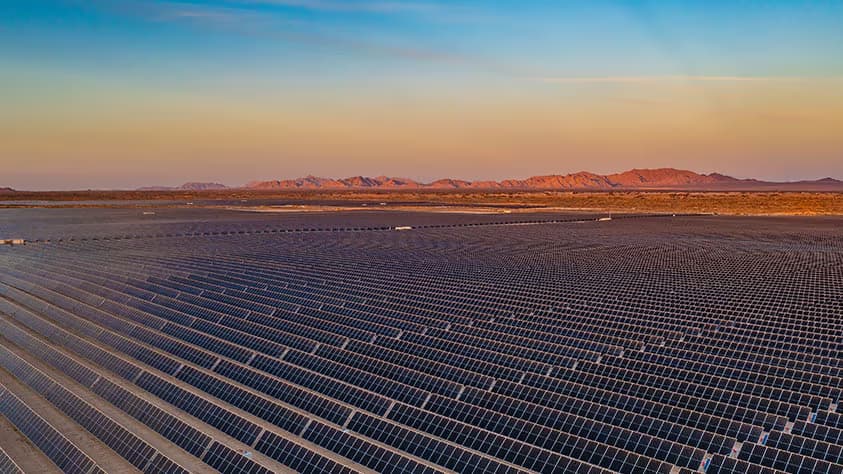
The first is the Central Fotovoltaica Rafael Galván, in Puerto Peñasco, Sonora. When its four phases are complete, this facility will reach 1,000 MW of solar capacity paired with 246 MW of battery storage, making it the largest solar plant in the Americas. Total investment exceeds 1.4 billion dollars. This is not a proposal. CFE tenders for the Puerto Peñasco complex are already visible in SCOEE, with Secuencia III (300 MW solar plus 103 MW of battery-backed support) already in procurement and Secuencia IV announced for 280 MWac with additional storage.
The second is Proyecto Oasis, in the isolated grid of Mulegé, Baja California Sur. This facility combines 72 MW of solar, 20 MW of battery storage, and green hydrogen production to guarantee continuous, zero-emission electricity supply, including during nighttime hours. Mulegé has historically relied on diesel generation to cover periods without sun. Proyecto Oasis replaces that dependency while adding a hydrogen layer that few isolated systems anywhere in the world have attempted.
Together, these two projects define a common thread in the federal plan: generation and storage are being built as an integrated system, with batteries treated as infrastructure throughout.
Battery Storage Is No Longer Optional in Mexico's Grid
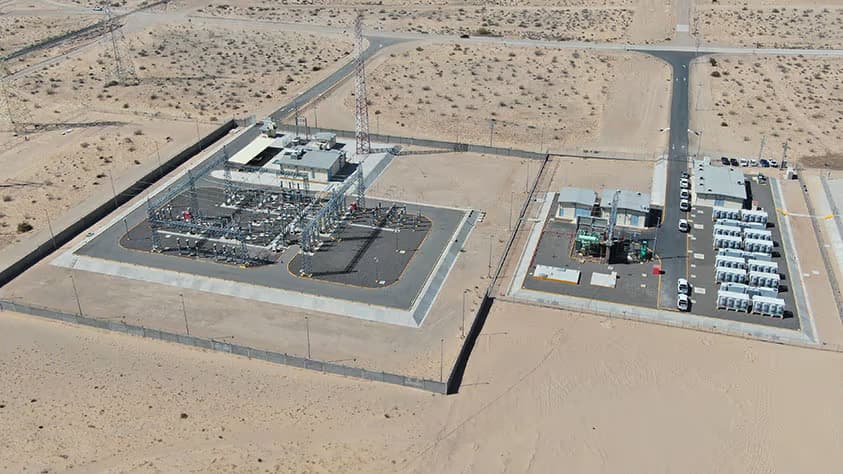
One of the most concrete elements of the federal plan is what it says specifically about storage. CFE's electricity plan commits to installing 2,216 MW of battery storage between 2025 and 2030. That figure is embedded in the Programa Sectorial de Energía and reflected in active tenders on CFE's procurement portal.
The Puerto Peñasco projects are the most visible examples, but they sit inside a broader program. CFE also announced a 2026-2027 transmission portfolio of 58 projects grouped into 49 bid packages, covering 387 works including 138 transmission-line works. This is the infrastructure that makes renewable integration physically possible at scale. Storage and transmission are being planned together.
The program also includes Concepción Mendizábal Fases I-II, a 576 MW solar project in Nava, Coahuila, which now sits within a regulatory environment that makes storage hybridization clearer and more accessible than at any previous point in Mexico's energy history.
The Regulatory Architecture Changed Last Year
The scale of the federal energy plan would have less practical impact without the regulatory restructuring that has happened alongside it.
The 2024 constitutional reform and secondary legislation published in March 2025 dissolved the Comisión Reguladora de Energía (CRE) and moved its functions to SENER and the newly created Comisión Nacional de Energía. For project developers and operators, this changed who issues permits, who processes interconnection requests, and how projects get structured commercially.
For storage specifically, two regulatory changes in early 2026 carry particular weight. In April 2026, CNE issued the Disposiciones Administrativas de Carácter General for integrating electricity storage systems into the national grid. A new model interconnection and connection contract published in March 2026 explicitly covers storage connections to transmission and distribution systems for the first time.
Before these changes, storage projects in Mexico faced legal uncertainty that complicated financing and contract structures. With formal disposiciones in place, utility-scale and behind-the-meter storage projects can be structured, financed, and contracted with a legal foundation that was simply not available two years ago.
The same framework applies to commercial and industrial operators considering battery storage for their own facilities. The legal path is now defined.
Where Private Investment Is Already Moving
The federal plan sets the direction. Private capital is already following with its own logic.
The most visible example is VEMO, which has grown into Mexico's largest public EV charging operator. VEMO now reports more than 1,400 connectors and more than 15 MW of installed charging capacity. In 2025, VEMO and BEEL closed MXN 500 million in infrastructure financing to expand the public charging network, followed by a US$250 million commitment led by Vision Ridge Partners. VEMO and Laneshift also opened the country's largest public EV freight hub in Mexico City, with 34 fast-charging bays, while NAFIN works on a financing mechanism for broader fleet electrification.
In the industrial sector, the nearshoring wave that has reshaped Sonora, Coahuila, San Luis Potosí, and Estado de México is generating its own energy story. Daikin completed a 1.2 MW rooftop solar installation in San Luis Potosí in October 2025. Yanfeng activated a 630 kW rooftop-plus-carport system in August 2025, offsetting 43 percent of site electricity consumption. GEODIS and Prologis launched a 619 kW rooftop solar project in Tepotzotlán in May 2025.
None of these are large projects by utility standards. But they represent a clear pattern: industrial operators in nearshoring corridors are investing in on-site generation, and the next conversation for most of them is storage, EV fleet charging, and demand management. The regulatory framework now supports all three.
What This Means for Operators in Mexico
The transformation described in this article is not distributed evenly across the economy. Some industries and geographies are at the center of it; others are watching from a distance. But the implications are relevant regardless of sector or location.
The generation matrix is shifting in ways that will affect tariffs and grid dynamics. As renewables grow from 23 to 38 percent of the national mix, and as 2,216 MW of storage enters service, the time patterns of when electricity is cheap, when demand peaks, and when grid congestion occurs will change. Operators who understand those patterns and can respond to them will manage energy costs better than those who treat electricity as a fixed monthly line item.
For operators in solar-rich states, Sonora, Coahuila, and San Luis Potosí, the calculation for on-site generation is already favorable. The legal basis for adding storage to those sites is now in place. The Yanfeng and Daikin installations are early examples of the industrial investment logic that is becoming more common in those corridors.
For fleet operators, the VEMO and Laneshift investments signal that commercial EV charging infrastructure in Mexico has moved past the pilot phase. The NAFIN financing mechanism under development is designed to make fleet electrification more accessible, and the federal electricity plan provides the grid capacity to support it.
The plan Sheinbaum announced on June 24 is, at its core, a statement about what Mexico's energy infrastructure will look like in 2030. The projects it named are already in motion. The regulatory framework is already in place. The private capital is already following.
For anyone operating in Mexico's industrial or commercial energy space, the transformation is underway.
Sources
- Sheinbaum anuncia histórico plan de expansión eléctrica de 32 mil megawatts | La Jornada
- Programa Sectorial de Energía 2025-2030 | DOF
- Disposiciones para integración de almacenamiento eléctrico | DOF / CNE
- CFE Boletín: Puerto Peñasco Secuencia IV y Concepción Mendizábal | CFE
- CFE Portfolio de Transmisión 2026-2027 | CFE
- Puerto Peñasco Secuencia III | CFE SCOEE
- VEMO y BEEL: Financiamiento MXN 500M | VEMO
- Laneshift: EV Freight Hub en Ciudad de México | The Climate Pledge
- Daikin San Luis Potosí | ForeFront Power
- Yanfeng San Luis Potosí | ForeFront Power
- GEODIS y Prologis Tepotzotlán | GEODIS